

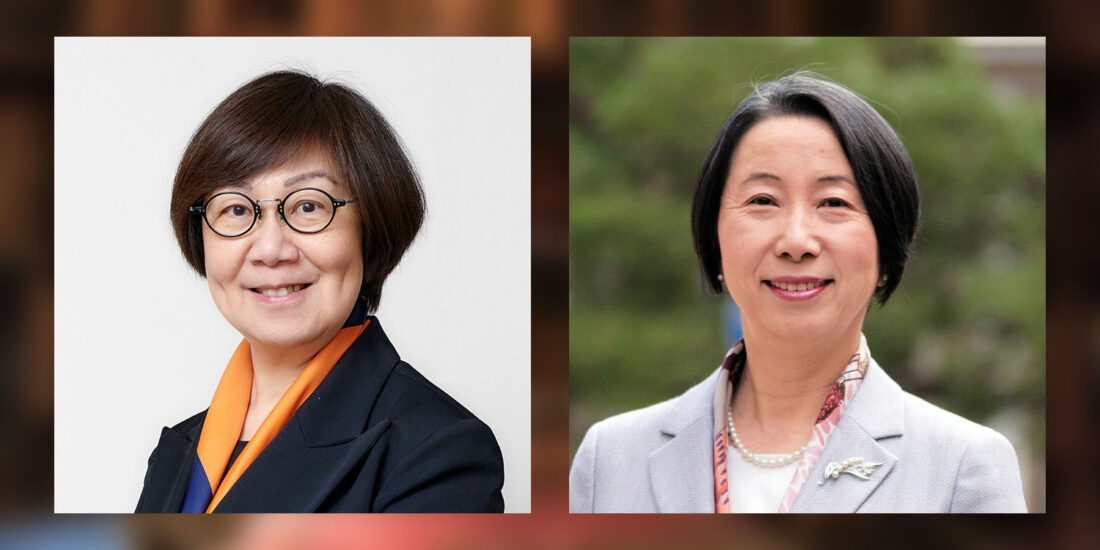
Professor Diana Khor, President of Hosei University, Japan, and Professor Yuko Takahashi, President of Tsuda University, Japan, have joined The 17th Asian Conference on Arts & Humanities (ACAH2026), The 16th Asian Conference on Cultural Studies (ACCS2026), and The 17th Asian Conference on the Social Sciences (ACSS2026) featured roundtable session titled ‘Senior Academic Leadership’.
Professor Khor and Professor Takahashi will speak on their personal experiences and trajectories in academic leadership as women in governing roles in Japanese higher education institutions. They will join Professor Umberto Ansaldo of VinUniversity, Vietnam, to provide tips on the skills needed to succeed in leadership positions.
This roundtable session will be held onsite in Tokyo at the Tokyo International Forum. To participate in ACAH/ACCS/ACSS2026 as an Onsite Audience member, please register for the conference via the conference website.
Speaker Biography
Diana Khor
Hosei University, Japan
 Professor Diana Khor is the President of Hosei University in Tokyo, Japan, a position she has held since March 2025. She previously served in several senior leadership roles at the university, including Executive Trustee and Vice President, Director of the Global Education Center, and Dean of the Faculty of Global and Interdisciplinary Studies. She received her Bachelor of Social Science in 1983 and her Master of Philosophy degrees in 1985 from the University of Hong Kong. She also earned her MA in Sociology in 1987, and her PhD in Sociology in 1994 from Stanford University, United States.
Professor Khor joined Hosei University in 1999 as an Assistant Professor in the Faculty of General Education. In 2003, she was appointed Associate Professor in the Faculty of Law and was promoted to Professor in 2005. Since 2008, she has served as Professor in the Faculty of Global and Interdisciplinary Studies.
Professor Khor’s academic background is in Sociology, with a focus on gender and sexuality, particularly in East Asia. As Vice President and now President, she has been committed to advancing global education, strengthening international engagement in higher education, and promoting diversity, equity and inclusion across the university.
Yuko Takahashi
Tsuda University, Japan
 Professor Yuko Takahashi was named the eleventh president of Tsuda College (now Tsuda University) in 2016. She holds a BA from Tsuda College, an MA in International Affairs from the University of Tsukuba, Japan; and an MA in History and a PhD in Education from The University of Kansas. Her major research areas are American studies, American social history, and gender history.
Professor Takahashi has held numerous academic leadership roles, including president of the Japan University Accreditation Association (2023–present), president of the International Federation for Research in Women's History (2020–2025), and president of the Japanese Association for American Studies (2018–2020). She also served as a commission member of the Japan-U.S. Educational Commission (2018–2022), is a council member of the Science Council of Japan, and a trustee of the American Studies Foundation. A two-time Fulbright scholar, she conducted research at Stanford University in 2003 and Wellesley College in 2013. Her publications include Tsuda Umeko no Shakaishi (Umeko Tsuda: A Social History, 2002) and Tsuda umeko - joshi kyōiku o hiraku (Umeko Tsuda: Pioneering Women’s Education, 2022).

Abstract
Senior Academic Leadership
This roundtable and interactive session will explore the career paths of academic leaders and provide tips on the skills needed to succeed in leadership positions. Speaking from national and professional contexts, the session leaders will describe their individual paths to leadership roles and the trade-offs that often accompany a career in higher education leadership and administration. Following the brief presentations, audience members will be asked to provide their own thoughts and observations on successful and unsuccessful leadership styles, as well as engage in an active discussion of the potential for academic leaders to make positive changes within their institutions and professional organisations.
